
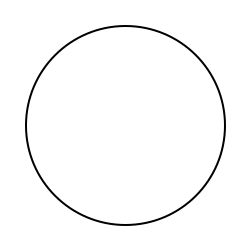
Circle
Symbolic Profile
Primary Name: Circle
Common Aliases: Monad, The Infinite Ring, Circulus Simplex, Ouroboros (in serpentine form), Mandala, The Boundless (Ain Soph / Apeiron), Anima Mundi, The Sacred Enclosure
Visual Core (the baseline shape): A continuous, closed curved line equidistant at every point from a central center; a 360-degree perimeter without beginning or end
Exoteric Keywords (surface meaning): Wholeness, unity, cycles, perfection, completion, eternity, protection, inclusion, harmony, infinity
Esoteric Keywords (occult meaning): The Monad (Primary Unity), Kether (The Crown), Ain Soph (The Limitless Light), Unmoved Mover, Primal Matrix, Squaring the Circle (Synthesis of Spirit and Matter), Consecrated Space
Astrological or Planetary links: The Sun (☉, Point within a Circle / Sol), The Entire Zodiac Ring (Wheel of Life), The Celestial Sphere / Empyrean; Path of Kether
Alchemical Associations: The Monad, Circulatio / Rotatio, Squaring the Circle (Reconciliation of the 4 elements into the Quintessence), Ouroboros (Self-contained unity), Prima Materia in its perfected state
Associated Metals: Gold (Sun/Monad), Electrum, Quicksilver (Mercury - fluid infinity)
Traditional Colours: Gold, Pure White (Kether / Unmodified Light), Deep Blue / Gold-dotted Indigo (The Cosmic Vault), Transparent/Crystal
Form and Origin
Natural or Material Inspiration
Inspired by the physical disk of the Sun and full Moon, the circular eye/pupil, ripples expanding outward in still water, the horizon bounding the visible world, cross-sections of trees and fruits, and the natural orbital paths of celestial bodies.
Geometric Philosophy
Represents the ultimate geometric primitive—a shape containing maximum area within a minimum perimeter. It embodies dynamic equilibrium and unity because every point on the circumference is equidistant from the invisible center (bindu). In sacred geometry, it represents Spirit (unbounded, infinite, frictionless, without beginning or end), whereas the straight line and square represent Matter and temporal boundaries.
Historical Evolution of the Form
Evolved from Neolithic stone circles (Stonehenge, Avebury) and solar wheel rock art into the Pythagorean Monad, the Gnostic/Hermetic cosmic sphere, medieval magic circles of protection (grimoire tradition), Eastern Mandalas and Yantras, and the alchemical emblem of the Squared Circle (Quadratura Circuli).
Mythological and Cultural Context
The Origin Point
Originating in Paleolithic solar/lunar cup-and-ring petroglyphs and Megalithic circular alignments across Europe, Asia, and Africa (c. 4000–2500 BCE), where the circle marked the sacred boundary separating order (Cosmos) from surrounding chaos.
Cultural Migration
Synthesized through Egyptian solar disc icons (Aten/Ra), Pythagorean geometry (the Monad as the source of all numbers), Hindu/Buddhist mandalas (the universe as a sacred circle), Native American Medicine Wheels, Islamic geometric arabesques, and Western ceremonial magic (the consecrated circle).
Folklore and Ritual Use
In everyday life and folk magic, the circle functioned primarily as a protective barrier and an oath of continuity. Practitioners cast circles on the ground using salt, chalk, or ceremonial blades to create a sanctuary invulnerable to malevolent spirits. Ritual movements around shrines—known as circumambulation—were performed clockwise (deosil) to attract solar blessings or counter-clockwise (widdershins) for banishing. The wearing of circular rings, bracelets, and crowns served as a talismanic sign of unbroken authority, protection, and eternal fidelity.
Esoteric and Psychological Depths
Jungian Archetypes
In analytical psychology, Carl Jung identified the circle—and specifically its complex form, the mandala—as the supreme archetypal symbol of the Self and psychological Wholeness. The circle represents the subconscious mind's spontaneous effort to organize, balance, and integrate contradictory conscious and unconscious elements. It maps the psychic center of personality, acting as an inner sanctuary where ego-awareness and the shadow are synthesized into a balanced, self-regulating unity.
Occult and Mystical Usage
In Hermeticism and ceremonial magic, the circle is the fundamental operational boundary within which the magician operates. Standing at the center point, the practitioner acts as the microcosmic reflection of Kether or the Unmoved Mover, shielded from hostile astral influences outside the perimeter. In Qabalah, the circle represents Ain Soph (Limitless Light) prior to creation, as well as the initial Sephira Kether (The Crown). In alchemy, it signifies the process of Rotatio and the closed vessel (Vas Hermeticum) within which the Prima Materia undergoes transmutation.
Dream Symbology
Dreaming of a circle signifies personal completion, emotional stabilization, the discovery of one's center, or the resolution of long-standing internal conflicts. An intact, glowing circle reflects psychic harmony and strong boundaries. Conversely, a broken, distorted, or leaking circle indicates breached boundaries, spiritual vulnerability, loss of integration, or ego-fragmentation. An expanding circle suggests growing consciousness, spiritual evolution, and the broadening of one's worldview.
Themes and Pairings
Core Thematic Associations
The primary themes associated with the circle are infinite continuity, primary unity, cosmic protection, cyclic renewal, total psychic integration, and the Unmoved Mover. It represents the eternal realm of Spirit transcending the mortal decay of time, serving as the foundational container within which all life, geometry, and cosmic manifestation unfold.
Traditional Pairings
The circle is traditionally paired with the Central Point (Point within a Circle / ☉), the Square (Squaring the Circle), the Triangle (Trinity within Unity), the Serpent (Ouroboros coiling into a circle), the Cross (Sun Cross / Wheel), and the Architect's Compass.
Contrasting Symbols
The direct polar opposites of the circle are the Square or Cube (representing static, bounded, terrestrial matter and physical limitations), the Straight Line or Arrow (representing linear, non-cyclic time and one-way directional movement), and Fragmented/Irregular Shapes (representing chaos, decay, and unintegrated entropy).
Quotations
"God is an intelligible sphere, whose center is everywhere and whose circumference is nowhere."
Hermes Trismegistus (attributed), The Book of the Twenty-Four Philosophers (Liber XXIV Philosophorum), c. 12th Century
"The circle is the first, simplest, and most perfect figure... It has neither beginning nor end, and contains within itself all other figures. Therefore it is the true symbol of the Monad, the Divine Being, who is without beginning or end, and in whom all things consist."
Heinrich Cornelius Agrippa, Three Books of Occult Philosophy (De Occulta Philosophia), 1533
"The mandala is an archetypal image whose occurrence is attested throughout the ages. It signifies the wholeness of the Self. This circular design portrays the psychic center of the personality, the innermost core which reconciles all opposites."
Carl Gustav Jung, Man and His Symbols / Collected Works, 1961
Reference Library
Notable Masterworks
- The Squaring of the Circle (Atalanta Fugiens, Emblem XXI) — Michael Maier & Johann Theodor de Bry (1618)
- Vitruvian Man (The Canon of Proportions) — Leonardo da Vinci (c. 1490, Gallerie dell'Accademia, Venice)
- The Cosmic Rose / Paradiso (Dante's Divine Comedy Illustration) — Gustave Doré (1868)
- The Great Turquoise Sun Stone / Aztec Calendar Stone — Mexica / Aztec Culture (c. 1479 CE, National Museum of Anthropology, Mexico City)
Primary Texts
- The Book of the Twenty-Four Philosophers (Liber XXIV Philosophorum) (12th Century Hermetic Treatise)
- Plato: Timaeus (Discussion of the spherical shape of the universe and the circle of the Same and Different)
- Heinrich Cornelius Agrippa: Three Books of Occult Philosophy (Book II: Mathematical Magic and Sacred Geometry of the Circle)
Related Entries
- Point / Bindu [The central source from which the circle radiates]
- Sun (Sol) [The primary celestial manifestation of the point within the circle]
- Wheel (Rota) [The dynamic, revolving application of circular geometry in time]